 By
By Quick Answer: CNC turning is a machining process where a cutting tool removes material from a rotating workpiece to create cylindrical parts such as shafts, bushings, pins, and fittings. Computer controlled positioning gives it the accuracy and repeatability that manual lathe work cannot match, which is why it remains one of the most widely used processes in precision manufacturing.
Nearly every industry that builds physical products relies on round parts somewhere in the assembly. Shafts, spindles, fasteners, connectors, valve stems, the list runs long. CNC turning is the process most of those parts start out as, and understanding how it works explains a lot about why it has stayed central to manufacturing for decades.
How CNC Turning Works
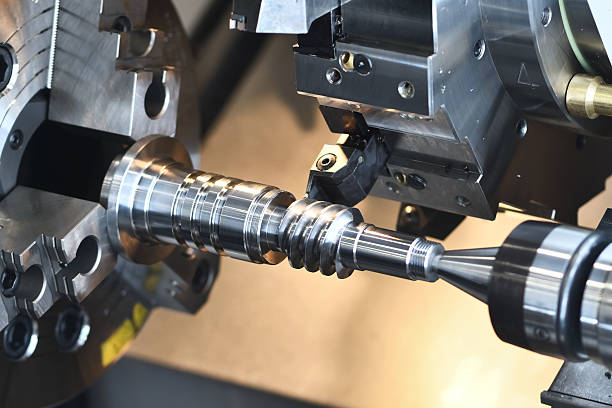
The workpiece, usually a round bar of metal or plastic, gets clamped into a rotating chuck. A cutting tool, mounted on a computer controlled turret, moves along the X and Z axes to remove material as the part spins. Unlike manual turning, where an operator adjusts feed and depth by hand and feel, CNC turning follows a programmed toolpath generated from a CAD model, so every part in a batch follows the exact same motion.
That programmed precision is the whole story here. A CNC lathe can hold tolerances that would be nearly impossible to repeat consistently by hand, often down to plus or minus 0.0005 inches on critical diameters, and it does so on part one and part one thousand without drift, assuming tooling wear is properly monitored.
Why CNC Turning Still Dominates Round Part Production
Additive manufacturing gets a lot of attention these days, and five axis milling can do impressive things, but neither has displaced CNC turning for one simple reason. Turning is the fastest, most economical way to produce a true cylindrical surface. Milling a round shape from a square blank means removing far more material and taking far longer. A lathe removes material in a continuous rotational cut, which is inherently efficient for round geometry.
Multi axis CNC lathes have also closed the gap on complexity. Live tooling lets a lathe drill cross holes, mill flats, and cut keyways without moving to a second machine, something covered in more depth when comparing turning to turn milling. Even without live tooling, a standard two axis CNC lathe still covers the vast majority of shaft, pin, bushing, and threaded fitting work that shops handle every day.
Where Precision Actually Comes From
A common question is what actually determines how tight a CNC lathe can hold tolerance. It is not just the machine. Tool rigidity, spindle runout, thermal stability of the shop floor, and even how well the raw bar stock is centered all factor in. Shops that specialize in high precision cnc turning, like Swiss Isle Precision, invest heavily in temperature controlled environments and in process gauging specifically because those variables matter as much as the machine itself once tolerances drop below a thousandth of an inch.
Materials commonly turned include steel, stainless steel, aluminum, brass, titanium, and various engineering plastics like PEEK, Delrin, and PTFE. Each material behaves differently under the cutting tool. Stainless steel work hardens if feed rates are wrong, aluminum can gum up on the tool if speeds are off, and brass machines almost forgivingly well, which is part of why it shows up so often in fittings and connectors.
CNC Turning Versus Screw Machining
People sometimes assume CNC turning and screw machining are the same thing. They overlap but are not identical. Screw machines, particularly Swiss type and multi spindle machines, are purpose built for extremely high volume production of small parts and often outperform standard CNC lathes on cost per piece once volume climbs into the tens of thousands. Standard CNC turning centers offer more flexibility for lower volumes, larger diameters, and parts that change frequently in design.
A Mistake Worth Avoiding
One error buyers make is assuming that tighter tolerance always means higher cost, full stop. In reality the bigger cost driver is often the ratio of tolerance to feature size, plus whatever secondary operations like grinding get added after turning. A large diameter part with a moderately tight tolerance can sometimes cost less than a tiny part with the same absolute tolerance value, since the tiny part is proportionally harder to control.
Frequently Asked Questions
Q: What is the typical tolerance range for CNC turning?
A: Standard CNC lathes commonly hold plus or minus 0.001 to 0.0005 inches on critical diameters, with tighter results achievable through process control and secondary finishing.
Q: What materials can be CNC turned?
A: Steel, stainless steel, aluminum, brass, titanium, and engineering plastics such as PEEK and Delrin are all regularly machined on CNC lathes.
Q: How is CNC turning different from CNC milling?
A: Turning rotates the workpiece while a stationary tool removes material, ideal for cylindrical shapes. Milling rotates the cutting tool against a stationary or repositioned workpiece, better suited for flat, angled, or prismatic features.
Q: Is CNC turning cost effective for small production runs?
A: Yes, since it requires no hard tooling like stamping does, CNC turning works well for both prototypes and full production runs.
Q: When should I choose CNC turning over screw machining?
A: Choose CNC turning for lower volumes, larger diameters, or designs that change often. Screw machining tends to win on cost once volume reaches the tens of thousands with a stable design.